 Guías
GuíasGuía
Free Competitor Website Analysis: A Practical Starting Checklist
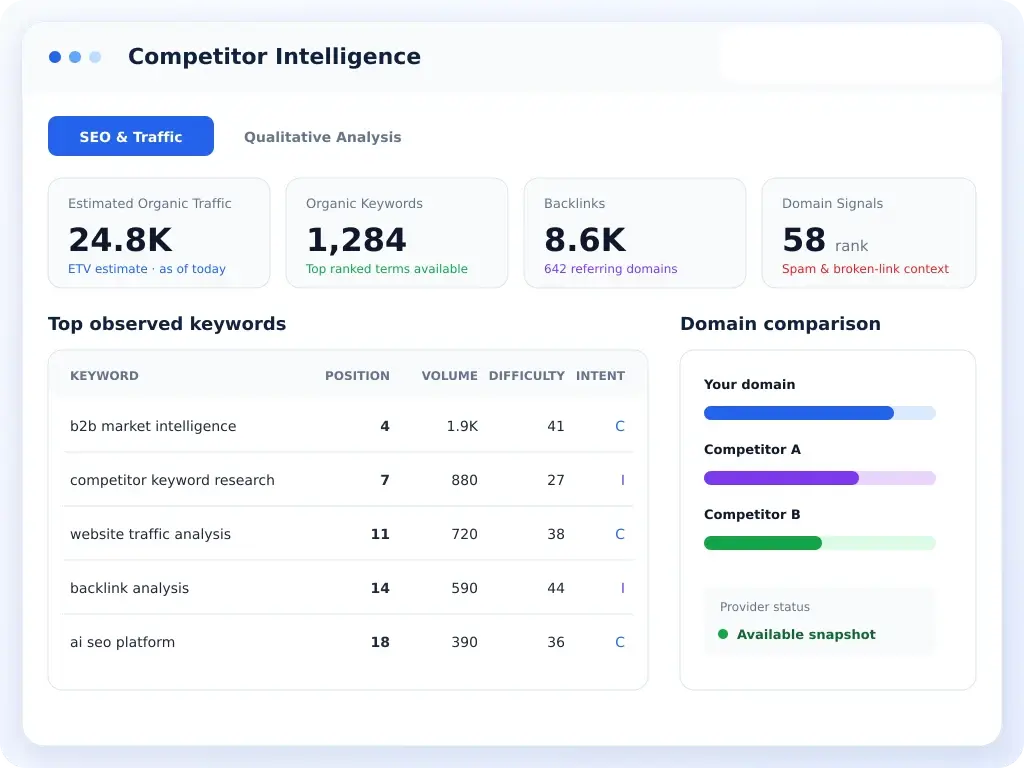
A free competitor website analysis can identify positioning, content, search, backlink, and market questions worth deeper investigation. It cannot reveal a competitor's private analytics, exact sales, or complete strategy, so the value comes from asking focused questions and documenting limitations.
Start with the business decision
Choose two or three genuinely comparable domains and decide whether you are studying positioning, organic visibility, content gaps, backlinks, or market entry. A broad score with no decision behind it creates noise rather than competitive intelligence.
Use public and provider-supplied signals as research evidence, not as guaranteed truth. Record the market, date, source, unavailable fields, and the first-party evidence needed before making a commercial decision.
What to check
- Homepage positioning and audience
- Observed keywords and search intent
- Estimated organic visibility with scope
- Relevant backlinks and referring domains
- Content gaps and next validation steps
Paso a paso
- 1
Define the exact outcome
Write the decision this research must support, the target audience, country, and the evidence that would make the result useful.
- 2
Collect focused evidence
Review the same public pages and supported search observations for each competitor. Keep country, language, device, domain scope, and date consistent.
- 3
Separate facts, estimates, and assumptions
Label every finding so an observed company, keyword, link, or page is not confused with estimated traffic, inferred intent, or an unverified commercial assumption.
- 4
Prioritize by relevance
Keep the opportunities that match the audience and product. Discard impressive-looking signals that do not support a realistic customer, content, or market action.
- 5
Take one measurable next step
Turn the strongest finding into a page, shortlist, outreach action, or test, then measure the result with first-party analytics and Search Console where available.