 Guides
Guide
How to Do a Competitor Analysis for SEO and Market Research
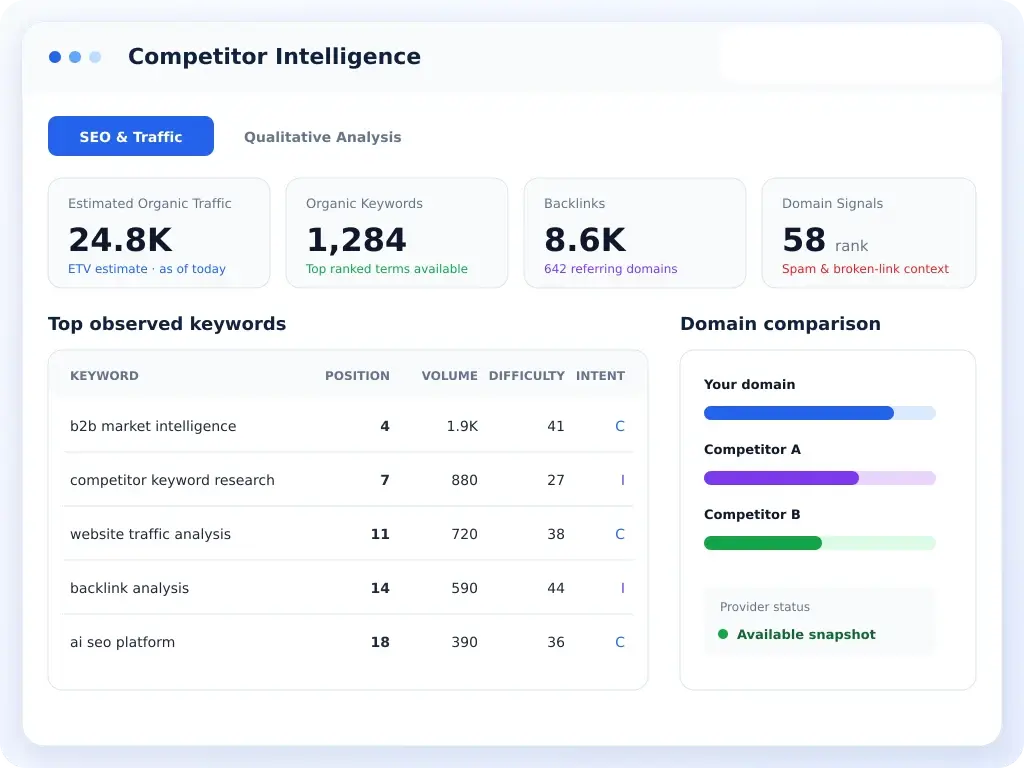
A useful competitor analysis is more than collecting rankings or copying a rival's keywords. It combines comparable search observations with company and market context, then records what is known, estimated, missing, and worth validating.
What a good competitor analysis answers
Start with a decision, such as choosing content themes, preparing a market discussion, or understanding a new category. Select genuinely comparable domains and keep country, language, and date assumptions consistent.
Estimated organic traffic is not a competitor's analytics. Keyword, ranking, backlink, and referring-domain observations can be incomplete or delayed, so label the source and use the result as research context rather than a market-share report.
Responsible comparison rules
- Separate observed, estimated, and qualitative findings.
- Do not infer quality, revenue, or compliance from a search signal.
- Use the same scope and settings for every domain.
- Follow public signals with direct commercial and legal checks.
Step-by-step
- 1
Define the comparison question
Write the decision the report must support. A clear question prevents an attractive but unfocused report from becoming a spreadsheet with no action.
- 2
Choose two or three domains
Use one reference domain and one or two comparable competitors. Confirm canonical domains and keep country and language settings consistent.
- 3
Separate observed and estimated signals
Label each metric. A traffic estimate is not GA4, and an observed keyword or backlink is not proof of commercial success.
- 4
Add qualitative company context
Review positioning, sector, market position, strengths, weaknesses, and opportunities alongside search observations. A smaller site may still be strategically important.
- 5
Turn findings into validation tasks
Prioritise a short list of hypotheses, assign an owner, and define the first-party, customer, or market evidence that will confirm or reject each one.